


Could the Chicago Bears Succeed With a "Homegrown" Recruitment Policy?
- Bilal Kamal
- Jul 3
- 5 min read


Few clubs in the world of sports have an identity quite like Athletic Bilbao. This Spanish soccer club has famously limited itself to signing players with Basque ties, sacrificing a larger talent pool in favor of regional identity. The policy has become one of the sport's most fascinating experiments, proving that local pride can sometimes outweigh star power.
The Basque club has been relatively successful using this policy and this made me wonder: What if the Bears adopted a similar philosophy?
Instead of signing free agents or drafting players from across the country, imagine a roster built entirely from players born and raised in Illinois. Looking at NFL talent from 2010 through today, would Chicago field a competitive team, or would the talent gap become too large to overcome?
The QB Problem Would Have Been Long Solved

Quarterback is the first position where the debate begins.
The Bears have spent much of the past 15 years searching for stability under center until Caleb Williams came to town.
If the Bears did go down the homegrown route, Kirk Cousins and Jimmy Garoppolo, both from the Northwest Suburbs, would be part of the quarterback room.
Regardless of how Bears fans feel about either player, that duo compares favorably to what Chicago has actually had for most of the last decade.
Instead of cycling through Jay Cutler, Mike Glennon, Mitchell Trubisky, Justin Fields, and several short-term veterans, the Bears could have relied on Cousins as a consistent starter while Garoppolo served as an experienced backup. That position alone arguably improves under a homegrown model.
But who would be protecting them?
Bryan Bulaga, David Diehl, Graham Glasgow, Ted Karras, and Dan Feeney have all enjoyed lengthy NFL careers. Collectively, they have started hundreds of games and earned multiple Pro Bowl appearances. Few teams could complain about that level of experience protecting the quarterback.
And considering the Bears up and down history regarding the offensive line, I think the homegrown quota would have helped with stabilizing the unit.
Good QB's but No Solid Weapons
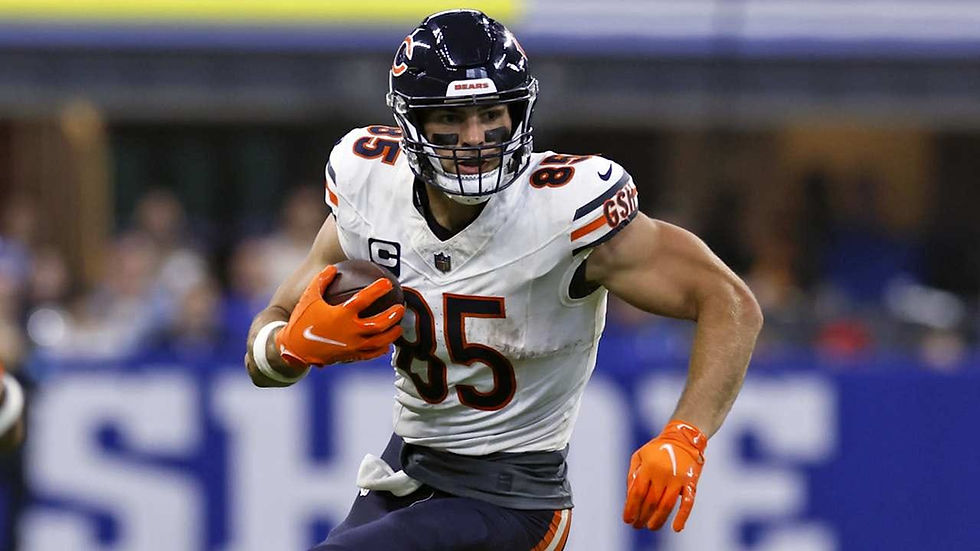
While the QB and O-Line play would be better and more stable, there are a lack of skill position players that are from Illinois.
The RB room would include Bucky Irving, Pierre Thomas, and Rashard Mendenhall who are serviceable, and I really do like Bucky Irving, but not as good as what the Bears already had with Matt Forte, David Montgomery, and D'Andre Swift over the years.
The RB rooms are at least comparable, but the WR room, on the other hand, is a big yikes!
Miles Boykin and Scotty Miller (who is currently on the Bears) have carved out respectable NFL careers, but they cannot match the production of players like Brandon Marshall, Alshon Jeffery, or D.J. Moore. I could cheat and put in Garrett Wilson (he was born in Chicago, but grew up in Ohio), but even still, I believe the non-homegrown WR room is still better.
The TE room is an interesting battle. The elephant in the room is Cole Kmet who fits both criteria (he is Illinois born and a Bears player), so he would overlap. In this scenario, I will keep him as a part of the Illinois TE room, so the Bears would have Greg Olsen, Zach Miller, Martellus Bennett, and Colston Loveland. A pretty good collection of tight ends.
The Illinois TE room would include Cole Kmet, Sam LaPorta and Robert Tonyan. Similar to the running backs, it would be very serviceable, but overall not as good as the Bears' options.
The offense would likely become more reliant on efficient quarterback play and a strong running game rather than explosive perimeter weapons if the Bears went homegrown.
Chicago Bears and Defense go hand and hand.

Going through the respective defenses, I can see how the Bears always end up with a very good defensive unit, because whether they went homegrown or not, the Bears would have ended up with a good defense.
Regarding the Illinois talent, Greg Newsome II has developed into an excellent cornerback, while Julian Love has become one of the league's more versatile defensive backs. Robert Spillane, Jack Sanborn (who is also back with the Bears), Tony Adams, and Lukas Van Ness give the defense quality starters at multiple positions.
However, if the Bears went the homegrown route, they would be replacing the likes of Khalil Mack, Julius Peppers, Akiem Hicks, Brian Urlacher, and Roquan Smith.
Overall, the floor remains surprisingly high because Illinois consistently develops NFL-caliber players, especially along the offensive line and on defense. However, the ceiling becomes much lower when elite free agents and first-round stars from across the country are removed from the equation.
The Bears' modern roster has been built around players from everywhere. Mack arrived from Oakland. Peppers came from Carolina. Montez Sweat was acquired from Washington. Brandon Marshall was traded from Miami. Those franchise-altering moves simply would not exist under a regional recruitment policy.
The comparison to Athletic Bilbao becomes even more interesting because success would be measured differently.
Bilbao has never tried to outspend clubs like Real Madrid or Barcelona. Instead, the organization embraces its identity and accepts the challenges that come with it. Fans celebrate seeing local players represent their community, even if championships become more difficult to achieve.
A homegrown Bears roster would likely inspire that same sense of pride. Seeing Illinois natives like Cousins, Kmet, T.J. Edwards, Greg Newsome II, Bryan Bulaga, Ted Karras, and Lukas Van Ness represent Chicago would create a unique bond between the team and its fanbase.
Would it produce more Super Bowl victories or deep playoff runs? Maybe.
Would it produce a team that truly represented the state of Illinois every Sunday? Without question.
In the end, the experiment shows that Illinois produces enough football talent to build a respectable NFL roster. It just doesn't produce enough elite, Hall of Fame-level talent every generation to consistently compete with a franchise allowed to recruit nationwide.
The Bears would still be competitive, but the modern roster assembled from players across the country ultimately offers a higher ceiling than even the best collection of homegrown Illinois talent.
Team Illinois vs Team Bears (2010 - )
Position | Homegrown Bears | Best Bears in the past decade |
QB | Kirk Cousins | Jay Cutler |
RB | Bucky Irving | Matt Forte |
WR1 | Garrett Wilson | Brandon Marshall |
WR2 | Miles Boykin | Alshon Jeffery |
WR3 | Scotty Miller | D.J. Moore |
TE | Cole Kmet | Greg Olsen |
LT | David Diehl | Charles Leno Jr. |
LG | Graham Glasgow | Josh Sitton |
C | Ted Karras | Olin Kreutz |
RG | Dan Feeney | Kyle Long |
RT | Bryan Bulaga | Darnell Wright |
DE | Robert Ninkovich | Julius Peppers |
DT | Solomon Thomas | Akiem Hicks |
DT | Trey Pipkins | Montez Sweat |
EDGE | Lukas Van Ness | Robert Quinn |
LB | T.J. Edwards | Khalil Mack |
LB | Jack Sanborn | Brian Urlacher |
LB | Robert Spillane | Roquan Smith |
CB | Greg Newsome II | Kyle Fuller |
CB | Julian Love | Charles Tillman |
S | Tony Adams | Eddie Jackson |
S | Clayton Fejedelem | Adrian Amos |
K | Jake Elliott | Robbie Gould |
P | Ryan Donahue | Pat O'Donnell |


Comments